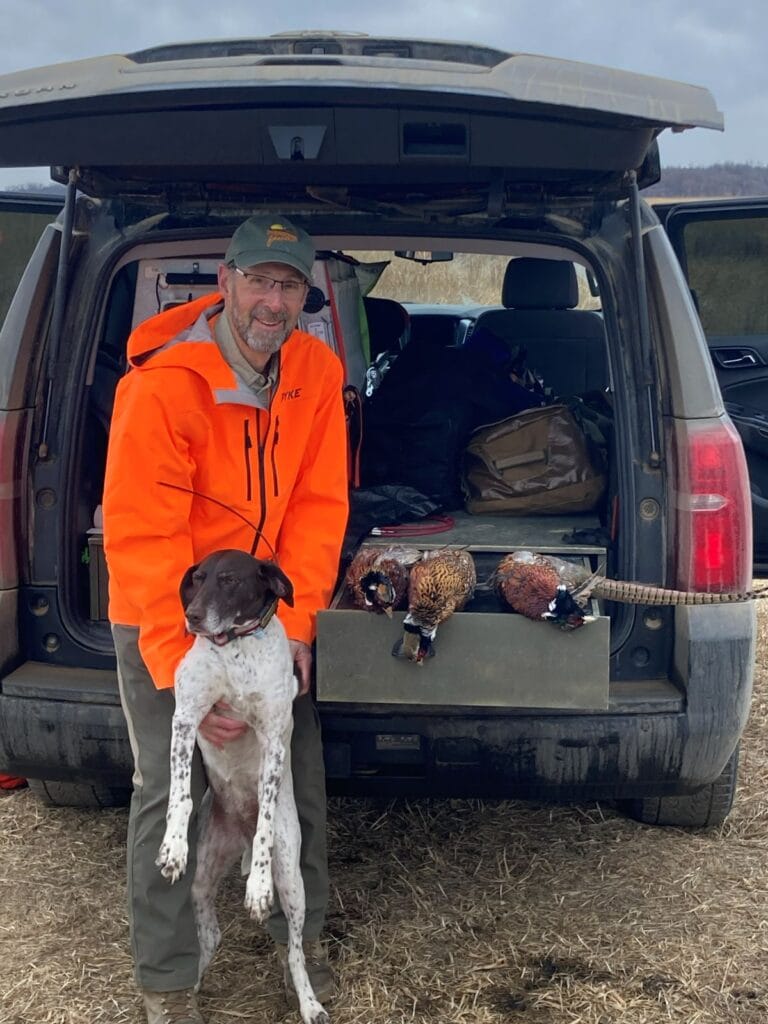
This is the 2025 pheasant hunting season wrap up. In this post I talk about the high lights and low lights of the season. I will provide a lot of statistics based on data that I log after every hunt.
Logging hunts and analyzing the data isn’t for everyone but for me personally I believe that it has helped us greatly. After every trip we talk about lessons learned, which we then apply for future hunts. I have statistics on every location we hunt. When we factor in environmental conditions such as drought years we have a better idea which locations will have birds. For this reason, I wrote the book called “The Pheasant Hunter’s Journal” so that hunters who are interested, can start logging.
Factors Affecting the Season
I went into this season knowing that a lot of things had changed from previous years. The impact of those changes turned out to much larger than I anticipated.
Access
From an access/hunting location perspective the greatest impact was the loss of access to private property that we have hunted for over 10 years. The landowner has worked for years to convert his family farm into a conservationists dream. In April of 2025, he sold the land to the county for use as a public park.
For me, the impact was huge. The farm was about 30 minutes from home. I would typically hunt it on weekends so that I wasn’t competing with other hunters for public ground. While we did harvest some birds off the property every year we still had to work for them. It was just nice to be able to go out on a weekend afternoon without driving 4 hours. Using data from 2019 through 2024:
- We averaged 9.8 trips per year to the farm. For those same years, we averaged a total of 13.5 trips in Minnesota. So the majority of our Minnesota hunts were to the farm.
- We harvested an average of 5.1 birds per year at the farm. For those same years we averaged 12.8 birds per year from all Minnesota hunts.
Knowing that I had lost access, I did spend quite a bit of time researching other public ground in Minnesota. In September, I took a day and drove around looking at locations that we could try. Throughout the season, we did try several new locations but none proved to be exceptional. In the end, the factors that turned out to be most significant were:
- All of the most promising locations are at least a two hour drive, just to get there. This means we would have to plan for an entire day. Allocating two full days per week was hard.
- I don’t like to hunt public ground on the weekend. We typically run into other hunters who encroach on where we are hunting.
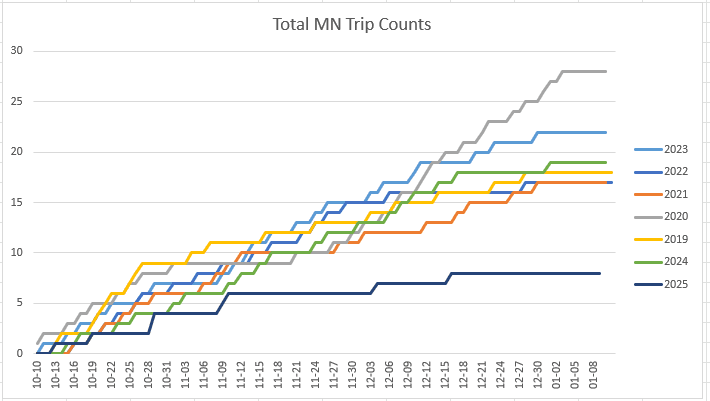
As a result, we just did not hunt Minnesota as much. The following graph shows a the drastic decrease in Minnesota Trips.
Bird Population
By late spring we were hopeful that bird numbers would be good. The previous winter had been mild and the spring while wet hadn’t been excessively cold.
Just prior to the season, both Minnesota and Iowa published their roadside survey results which were excellent. We had high hopes for the season.
In fact, we did see a lot of birds, at a distance. When I compare the number of roosters seen per mile walked, it turns out that 2025 was significantly above average.The number of roosters shot per mile walked was average. The reason for the discrepancy is that we saw a lot of birds well beyond range.
I do have to wonder whether the the glowing forecasts caused a lot more hunters to hunt this year. For us it seemed like early season birds were acting like late season, heavily hunted birds. Lots of runners and wild flushes.
Habitat
The prairies were in better shape than I have seen for many years. After years of drought, we had a summer with significant rain. The prairies were in great shape, with very tall grass and dense stands of grass and weeds.
It made for tough walking though. My first hunt of the season I went to a WPA that was so thick it took me 3 hours to walk less than 1.5 miles. The heavy cover also benefited the birds. They were able to run freely without any natural breaks to slow them down.
Health
From a health perspective, early in the summer I was concerned whether I would be ready given that I had finally replaced my left knee. To insure I was ready I set a goal to walk a mile per day for every day from the end of May to openings day, which was about 132 days. I ended up walking close to 200 miles before the season. My left knee felt good. Unfortunately, all of the walking, especially on the hills, finished off my right knee. So, I was in slightly better shape staring the season than last year but by season end, my right knee was done.
Special Circumstances
This year I was invited to a South Dakota hunt by a friend from Pennsylvania. The week long trip overlapped the Minnesota season, which was fine. I have always wanted to hunt South Dakota. The South Dakota trip was not included in the statistics.
The hunt was not what I was used to. It was based on a large group of hunters driving corn. There were tons of birds. It was a very different experience. I hope to put out a video that highlights the differences between my normal hunting methods and the South Dakota method.
It was also interesting how South Dakota has embraced pheasant hunting. The economic benefits have to be significant.
The other circumstance was our “granny tour” over the holidays. We did a trip to visit our mothers which was well worth the time, even if I missed a week of hunting.
Weather
This year the weather also had an impact, like it does every year. Early season, there was a lot of wind. We were seeing birds but everything was flushing wild.
Then we had snow. More than we have seen for a few years which, when combined with robust prairie growth made walking a challenge.
Miles Walked and Trip Counts
As stated above, the loss of private ground, the trip to South Dakota and the weather all played a role in when and how often I hunted. This first graph shows the total trip counts over the last few years.

You can see that 2025 had dramatically fewer trips. The seven year average is 28.1 trips per year. I did 17 in 2025.
The next chart shows my miles walked.
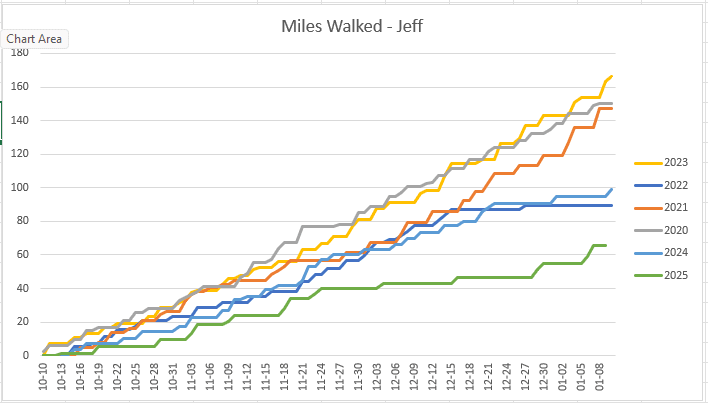
It shouldn’t be a surprise that I walked a lot fewer miles given the reduced trip count and the heavier cover. Over the last 6 years, I averaged 119 miles per season while the 2025 total was just 66.
Birds Seen and Harvested
was The first graph shows the number of roosters that we saw.
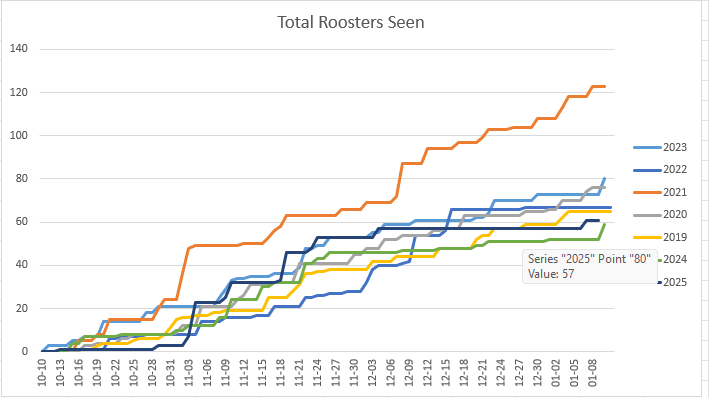
This of course is down, considering the reduced number of trips and miles walked. That also implies that had we had an average number of trips and mileage that we would most likely have seen a lot more roosters.
The following chart shows the number of roosters shot.
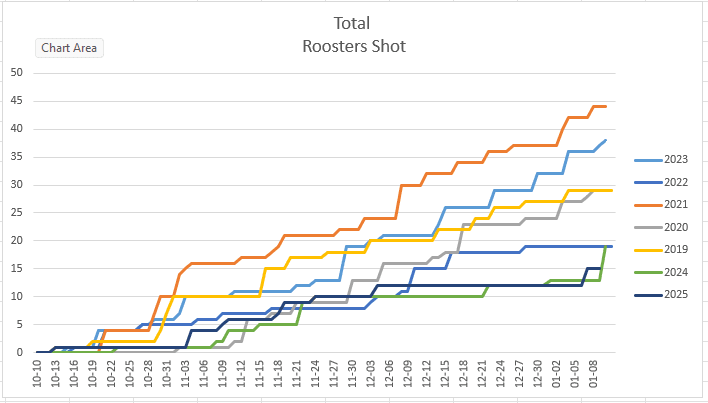
Again, this reflects the reduced trip and mileage counts. When I calculate roosters shot per mile walked, 2025 was an average year.
Lessons Learned
One of the most significant challenges this year was getting quality video. IT seemed like no matter what I did, the camera was always tilted down. I tried adjusting the view using the phone app, I tightened down the mounting bolt excessively. No matter what, I still was not getting decent video. While I was editing the week 13 video I noticed that the brim of my hat would come in and out of the frame. At that point, I realized that the hat itself was flexing. I need to change how I mount the camera to my hat.
I figured out that Willow will find birds but not retrieve them. Her idea of finding is to locate the bird, pick it up, drop it and then leave. I figured out that I can use my handheld to see where she has been and where she may have stopped.
I confirmed what I have seen before. The Garmin 200i and TT15 collars can be confused on dog location when the dog is in really tall, heavy cover.
Cattails do not guarantee birds.
Summary
The 2025 season was very different than the last few years. The number of trips and miles walked were way down. The total bird harvest was down as well. The prairies were in good condition and there were birds but it seemed like they were harder to hunt this year.
2026 will be interesting. I replaced my other knee a week after the 2025 season ended. Recovery is going slower than last year. Stella turned 10 near the end of the season. She did slow down a little bit this last season. I need to make sure she stays in shape over the summer. I hope to shot more sporting clays this year. From the stats I can see that it has helped me.