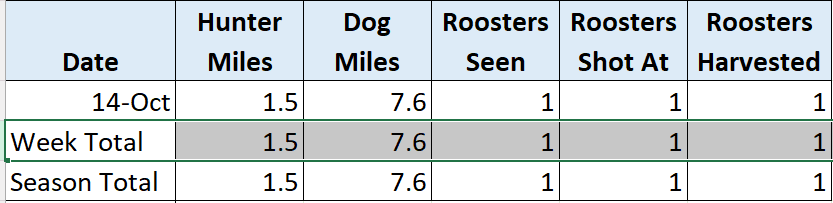
The 2025 Week 1 recap includes a little bit about my preseason as well as my first hunt of the year. Based on Minnesota and Iowa roadside surveys it should be a good season.
Preseason
After years of delaying, I finally had a knee replacement in mid-January. I knew that it would take time to recover and a lot of work to be ready for the 2025 season. As of May 30th, there was 136 days until the start of the Minnesota season so I set a goal that I would walk 136 miles, before the season started. I started slow but within a couple weeks I was doing a little over two miles per day in the park behind the house. Not every day but close. The dogs took turns going and they were pretty insistent that they had to walk every day. When the season opened I had logged 191 miles, so I felt pretty good.
Then I started taking the dogs to a local WMA. With all the rain we had this summer the cover was really thick. I was struggling a bit going through the heavy cover. Between two hip replacements and a knee replacement within the last three years my range of motion is decreased and I don’t have as much strength to lift my legs. I am hopeful that as I hunt more it will get better.
On one my of trips to a WMA with Stella I saw a group of about 8 birds get up, fly 50 yards and drop back in. So I took Stella towards them. She got birdy and tracked them until they flushed. There were several hens and at least two roosters. She continued tracking and after about 75 yards another rooster got up. Coming back from that trip I noticed that she was bleeding from the top of her right rear foot. There was a small skin tag that was opened up by the grass. I took her in and had the tag removed so that it wouldn’t become a bigger problem later in the season. I didn’t realize that removing it caused an even bigger wound.
October 14th - MInnesota
My first hunt of the season was a solo hunt to a Waterfowl Production Area (WPA) in central Minnesota. I expected the cover to be thick but was surprised how thick it was. Walking was challenging.
I had Willow because Stella was still recovering from the skin tag removal surgery. Willow covers a lot of ground and can tend to lose track of me. With the heavy cover that was especially true. At one point she was about 150 yards away and I could tell from the GPS collar handheld that she was searching for me. Then I heard a plaintive howl. I yelled and she started heading my way.
Soon after that we were working into the wind. My handheld beeped that she was on point and then I heard a rooster cackling. It had flushed from about where Willow was and he was flying right at me. When he saw me he turned and I dropped him in grass that was about 7 feet tall. Since it was a wild flush, I did not get it on video.
Now the real challenge was finding him. Willow is not a retriever. She usually goes and finds the birds, picks them up then drops them to look for another. I had marked where the bird fell and walked to that spot. I used a piece of flagging tape to mark the spot then tried to get Willow to help me look. She came over and at one point the handheld indicated that she had stopped. Then she started to move again.
I started walking a grid pattern around where I had marked. After about 20 minutes I was starting to give up hope when I found the rooster laying out in a small opening in the grass. He was about 10-12 feet to the left of my mark. At that point I decided we were done for the day. I didn’t want to take a chance that I would shoot another bird and not be able to find it.
When I got home I cleaned the bird. Interestingly enough I found tooth marks on the breast typical of when a dog picks up a bird. When I downloaded my track from the GPS handheld and compared it to Willow’s I figured out that Willow had indeed found the bird, picked it up and then moved on.
Video
There is a short video this week but nothing special. It has a couple short clips of Stella working the birds in preseason and then a couple clips of the heavy cover at the WPA.
Lessons Learned
I think my biggest lesson learned this week was that Willow will find downed birds and that I can possibly use my GPS handheld to track were she was in an effort to find downed birds.
The other lesson deals with marking the fall of a bird. When we talk about “marking” it means taking careful note of where a bird falls. Typically, you identify a landmark right in line with where the bird disappeared and then walk that line. What I realized is that when a bird is falling, they are typically traveling laterally as well as vertically. When I take a mark in 7 foot tall grass on a bird that is falling from right to left, the bird will actually be several feet to the left side of my site line.
Summary
The 2025 season is just starting. The weather and scheduling conflicts limited me to one hunt this week.